Friday, 30 November 2007

Get Shorty and walk tall

Screenwriter, William Goldman famously said of Hollywood and the screen trade that "No-one knows anything." It is this adage that is exploited to the full in Barry Sonnenfeld's 1995 big screen adaptation of Elmore Leonard's novel Get Shorty.

It stars John Travolta as Chili Palmer a mob debt collector hitting on Hollywood. Ably supported by Gene Hackman, Rene Russo and Danny DeVito, this tongue in cheek gangster/ romantic comedy lifts the lid on how movies do... or don't get made.

The jazzy soul based score credited to John Lurie is as cool as Chili Palmer and owes a fair debt to Booker T and The MG's who also turn up on the soundtrack along with US3, Morphine and Greyboy. Musically, the Get Shorty soundtrack has less in common with Out of Sight, another Elmore Leonard adaptation and is more in tune with Jamshied Shariff's excellent score for the Nickelodeon feature Harriet The Spy or George S Clinton's swampy score for Wild Things. Each has that widescreen swagger that makes you want to wack up the bass and wear Ray Bans in restaurants.

ANGEL - live fast die never

Angel was a darker more adult spinoff series from Joss Whedon's phenomenally successful Buffy The Vampire Slayer. Despite this excellent pedigree, a cast you really cared about and Whedon's witty words and caustic quips, Angel was sadly spiked by the network after five seasons. By no means a failure, but still a sad demise for a TV show that got it in the neck when it deserved a longer life. (Browncoat Firefly fans will be familiar with this scenario).

Removed from Buffy's Sunnydale environs to the streets of Los Angeles, the series followed the exploits of Angel (aka Angelus/Liam), a vampire cursed with a soul who searching for redemption, fought evil plaguing the city with the help of his associates including Cordy, Wesley, Fred, Lorne and Gunn.

Whereas Buffy The Vampire Slayer featured music from indie bands in many of its sequences, the Angel score with the exception of its excellent viola based indy rock theme by Darling Violetta, was more orchestrally focussed. Generally, the action cues utilized familiar instrumentation like bubbling sequenced electronics, orchestral stabs and that old soundtrack standby, the anvil. The quieter more reflective sequences accentuated Angel's lonliness and remorse. But it wasn't all doom and despondency especially when the old green queen Andy Hallett in his Lorne persona was pumping out Lady Marmalade and It's Not Easy Being Green in an over the top Vegas style.

Angel left our screens confronting a gang of unpleasant unworldly beasties bent on ending the world as we know it. He and his team will be sadly missed but you can still relive the high points of the big blood-guzzler trying to save us mere mortals by giving this score a listen.

The united colours of Pleasantville

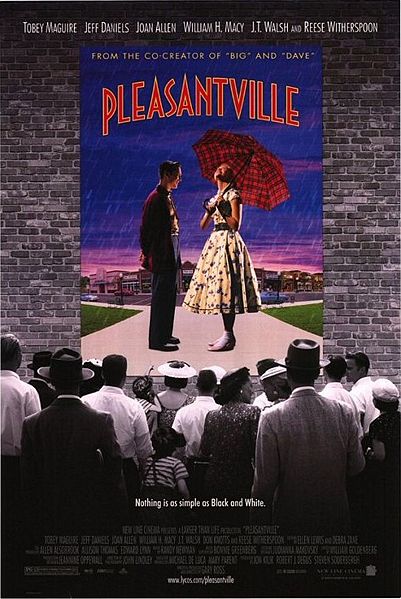
The term 'Capraesque' could easily be applied to Gary Ross' delightful 1998 feature Pleasantville. Starring Tobey Maguire, Reese Witherspoon, William H. Macy, Joan Allen, and Jeff Daniels, Pleasantville pitches modern day teenage twins into the world of the black and white 1950s titular television town where everything is 'swell' and sex and toilets don't exist.

As a result of the actions of David (Tobey Maguire) and his sister Jennifer (Reese Witherspoon), the Pleasantville population and the environment literally transforms from black and white into colour.

Pleasantville is for me one of those great heartwarming, lump in the throat movies like Frank Capra's It's A Wonderful Life or Lost Horizon. Apart from the stunning cinematography and an excellent cast, Pleasantville has two threads of great music. The first is an Americana-styled score by Randy Newman while the second is a dream jukebox of early Rock'n'Roll and Jazz classics.

You get some real crackers like Presley's Teddy Bear, Gene Vincent's Be-Bop-A-Lula, Miles Davis' So What, Brubeck's Take Five and Etta James' gorgeous At Last. Also included is Fiona Apple's sonambulistic rendition of the Beatles' Across the Universe and hearing la Apple's whistful vocals and Randy Newman's touching Real Rain fair brings a tear to the eye.

Tuesday, 27 November 2007

Fantastic Planet / La Planete Sauvage

René Laloux’s trippy psychedelic sci-fi animated feature from 1973, based on Stefan Wul’s novel Oms en série, was a co-production between France and Czechoslovakia.

Fantastic Planet tells the story of the fight for freedom by humans (Oms) kept as domesticated pets by an alien race of blue humanoid giants called Traags. The film is seen as an allegory of the Soviet invasion of Czechoslovakia in the late '60s.

I first came across this little gem of a film when it was part of a double bill with Crystal Voyager - a surfing movie that used Pink Floyd's Echoes to frame the action. But I digress..... Currently out of print, Alain Goraguer's memerising psychedelic jazz score for Fantastic Planet is the perfect accompaniment to a science fiction cult classic.

Sunday, 25 November 2007

Performance - Nothing is true, everything is permitted.

The late 1960's were a transitional time. The so-called Summer of Love was long gone, hippies became yippies, drugs became heavier and things were getting darker. Many musicians and film makers were responding to the zeitgeist with projects like Zabriskie Point and the disturbing Performance - famous for its casting of Mick Jagger and its graphic depictions of violence, sex and drug use.

Filmed in 1968 but not released until 1970 Perfomance was directed by Donald Cammell and Nicholas Roeg and was initially envisioned as a Swinging 60's romp starring Marlon Brando.

With a dramatically re-written script dealing with identity crisis, the lead role eventually went to distinguished actor James Fox who played 'on the run' psychopathic gangster Chas who seeks refuge in the basement of a house owned by former rock star Turner played by an androgenous Mick Jagger - a quantum leap from the wrinkly beknighted roue and corporate huckster of today.

With genuine gangsters turned thesps in the cast, it is rumoured that Fox took part in a real robbery as part of his research into his part and after the troubled production closed, he took a sabbatical from reality in the nether world of heroin addiction. There are also stories that some of the sex scenes were not simulated and footage exists of some of the principals engaged in some onscreen hanky panky.

The soundtrack produced and written by veteran knob twiddler Jack Nitzche (apart from Jagger and Richards' Memo from Turner), is both intriguing and terrifying, being a melange of folk, blues, wailing and primitive electronica. Ry Cooder's distinctive slide guitar is all over the score and his open tuned guitar style clearly made an impression on the Stones and can be detected on much of the band's late 60's and early 70's output.

The stand out track that most Stones fans seek out is of course Jagger's sinister solo spot Memo from Turner. Although the Stones recorded their own version which eventually saw the light on their patchy odds and sods release Metamorphosis, it fades in comparison to the snarling, satanic swagger of the film's original. Other highlights include The Last Poets' proto-rap Wake up Niggers and the scary Turner's Murder, which features Merry Clayton, who provided the soulful vocals for the Stones' Gimme Shelter, wailing over Beaver & Krause's thunderous electronica.

"The only performance that makes it, that makes it all the way, is the one that achieves madness."
Drugstore Cowboy - Elliot Goldenthal

The critically acclaimed Drugstore Cowboy from 1989, was writer / director Gus van Sant's breakthrough movie. With a cast including Matt Dillon, Kelly Lynch, Heather Graham, and William S. Burroughs, Drugstore Cowboy was filmed mainly around Portland, Oregon. It tells the story of a group of drug addicts travelling across early 1970's US robbing pharmacies and hospitals to support their habit.
Drugstore Cowboy's quirky film score is made up of an inspired if perverse selection of 60's hits plus Elliot Goldenthal's own slightly avant-garde compositions. Drugstore Cowboy was among Goldenthal's earliest movie scores and is about as far away as you can get from his big budget offerings. Instead he uses a small ensemble including keyboards, synths, sax and digeridoo. Well worth a listen.

100 Years of Cinema

For soundtrack buffs there are a great many collections available that address certain film genres, like War, Westerns, Romance, Musical etc. To get round the labyrinthine copyright issues, compilers often have to miss out crucial scores or make do with re-recordings. This is not the case with The Official Cinema 100 Album, which brings together original recordings from 34 feature films.

I have seldom found a soundtrack collection that is so diverse. The first part encompasses such classic scores as: Things To Come; Casablanca; Ben Hur; Breakfast at Tiffany's; Dr No; A Shot In The Dark and 633 Squadron; while the second part features such cinematic delights as Dr Zhivago; Grand Prix; The Thomas Crown Affair; Out of Africa and The Piano to name but a few.

Unfortunately it appears to be out of print but if you are looking for a comprehensive collection of classic movie music, The Official Cinema 100 Album is an essential addition to any soundtrack collection.